Legal Notice

Legal Notice to all visitors: Google hosts this site and uses certain Blogger and Google cookies, including, but not limited to, Google Analytics and AdSense cookies. By remaining on this site, you are consenting to the use of Google cookies and other data collection by Google.

"Beware that, when fighting monsters, you yourself do not become a monster..." ― Friedrich W. Nietzsche

Definition of Bigot: a person who is intolerantly devoted to his or her own opinions and prejudices; especially : one who regards or treats the members of a group with hatred and intolerance.

"When the whole world is running towards a cliff, he who is running in the opposite direction appears to have lost his mind." ― C. S. Lewis

See Disclaimer of Endorsement at the bottom of this page.

Translate

Showing posts with label Decoupage. Show all posts

Wednesday, August 27, 2025

"Crescent Moon Occult (Cigar Box)" - Wood Box

© All Rights Reserved
(Click on image to enlarge)

I made this Crescent Moon Occult rustic design wood box using a paper cigar box.

I painted over the edges of the cigar box and labels using Plaid Apple Barrel Outdoor Indoor Gloss Acrylic Black Paint (20662E), using two coats of paint. But I left the bottom as is.

(Note: I intentionally left the cigar labels on the box, and fully or partially decoupaged over them. I also wanted a distressed, aged look, so I allowed the paint to get scratched away.)

The steps are similar to the ones here.

Tuesday, September 24, 2024

"Dark Raven (Cigar Box)" - Wood Box

© All Rights Reserved
(Click on image to enlarge)

I made this Dark Raven wood box using a paper cigar box.

It is actually a "redo" of a box that got water damage on the bottom. I painted over the edges of the original design using Martha Stewart Vintage Gold Metallic Paint (346 433 / M18121), using one coat of paint. But I left the bottom as is.

(Note: I intentionally left the cigar labels on the box, and fully or partially decoupaged over them.)

The steps are similar to the ones here.

Saturday, May 4, 2024

"Occult Skull" - Decoupage Wood Box

© All Rights Reserved
(Click on image to enlarge)

I made an occult skull wood box, using a wood cigar box. (Note: I intentionally left the cigar labels on the box, and fully or partially decoupaged over them.) I used the same design as I did for this "Occult Skull" - Decoupage Wood Circle.

The steps are similar to the ones here.

Thursday, January 25, 2024

"Raven Box" - Decoupage Wood Box

© All Rights Reserved
(Click on image to enlarge)

I made another Raven wood box, using a wood cigar box. (Note: I intentionally left the cigar labels on the box, and fully or partially decoupaged over them.)

The steps are similar to the ones here.

Saturday, November 4, 2023

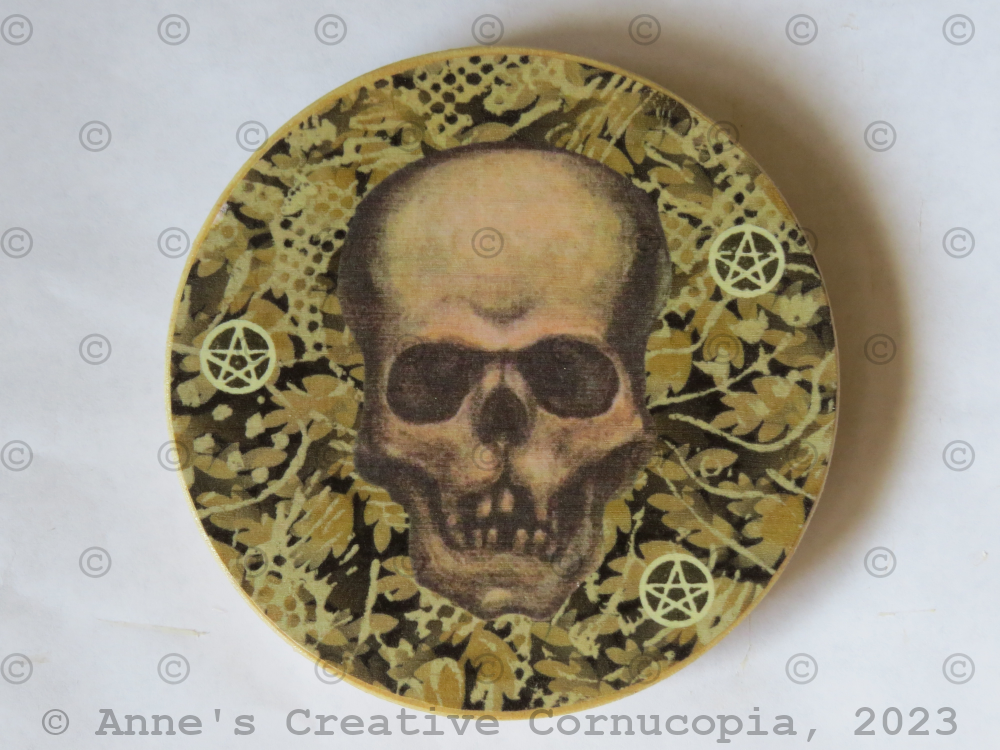
"Occult Skull" - Decoupage Wood Circle

© All Rights Reserved
(Click on image to enlarge)

I used the wooden lid from a jar candle to create a decoupage circle art piece that I'm going to add to my Halloween decorations.

The steps are similar to the ones here.

Sunday, November 27, 2022

"Ouija Raven Box" - Decoupage Wood Box

© All Rights Reserved
(Click on image to enlarge)

I made another Raven wood box, using a wood cigar box.

The steps are similar to the ones here.

Tuesday, April 5, 2022

"Gold Brown Raven" - Decoupage Wood Box

© All Rights Reserved
(Click on image to enlarge)

I made another Raven wood box, using a Hobby Lobby wood playing card box.

(Note: due to covidflation, the box price has gone from $1.99 to $2.49. Covidflation is the result of two years of World Wide Lockdowns for covid-19, yet the US Government is now claiming inflation is Russian President Putin's fault. I guess I was dreaming, back in August 2021, when US news reports said the US Government was saying inflation was "transitory". Forbes Aug 18, 2021. And if you don't trust Forbes as a News source, CNN had similar articles about inflation in that same time frame.)

I created this using GIMP 2.10.30.

The vintage images are from an Internet search. (See the side of my blog for links.)

-----

Decoupage Steps

Using an InkJet printer, print the design/image on regular paper.

Allow ink to dry completely. (Approximately 12 to 24 hours.)

Cut out design and make any necessary cuts to fit it onto the box (if there wasn't enough of a tolerance allowed, and it needs to be trimmed smaller).

Paint box, leaving unpainted any areas that will be covered by the design, to save on paint consumption.

Approximately 12 to 24 hours after the design was printed, decoupage it to the box as follows:

Cover working area with plastic wrap (or any other material that the paint and sealer won't stick to).

Apply Liquitex Matte Gel (or Gloss Gel) to the box top, carefully position the design above the top, so that it is straight, then place it down.

Place plastic wrap over the top, then brayer down the image. (Note: I used a clear plastic bread storage bag.)

Repeat that step for one side, then the other side.

Allow several hours for drying time. (Note: I didn't wait long enough, and then the top bubbled a little when I put the first sealer coat on it.)

Carefully cut the box side seams with an exacto knife, box cutter, window pane scraper, etc. (Notes: use a rocking motion, trying not to cut the seam incorrectly. If you accidentally cut away parts of the side image, declare it a "rustic" look. If the side seams tear and can be folded over inside the box edge, decoupage that down, but that might cause the box to stick shut once closed.)

Apply Liquitex Gloss Gel, starting with the top, and working to the sides. (Note: the ink does NOT run when using Liquitex Gel, but the finish has brush stroke lines in it, instead of being smooth.)

Allow several hours for drying time, between each sealer coat that is applied.

Wednesday, March 3, 2021

Decoupage Bird Napkin Wood Cigar Box - Photograph

© All Rights Reserved
(Click on image to enlarge)

I made a decoupage bird box, using a wood cigar box.

I created this using a 3-ply paper napkin, which I separated to use only the ply with the image on it.

First, I tried to remove all of the cigar labels and underlying label glue that were on the box.

Then I painted the box with one coat of Apple Barrel Antique White matte acrylic paint (20505E) and let it dry. (Notes: (1) I left the box hardware on, and painted over it, but scraped it off somewhat, after the paint was dry. (2) Where the cigar labels had been, the paint didn't adhere as well as it did on the rest of the box. But I decided it added to the grunge / old / vintage effect look that I wanted, so I didn't do a second coat of paint.)

Next I used Liquitex Matte Gel as my decoupage medium, and put the napkin onto the box top, lid front and back edges, and lid box hardware. I used plastic wrap to press down on the napkin, and also used a brayer across the top of the plastic wrap that was on top of the napkin. (See: How To Decoupage with Paper Napkins (plastic wrap tip). )

When that was dry, I repeated the same step for the box sides, using leaf sections from the napkin.

When that was dry, I repeated the same step for the box front, using leaf sections from the napkin.

Note: For the sides and front, I cut out leaf sections from the napkin, experimented with how the layout of them should look first, before doing the actual decoupage step. Unlike the top, where the napkin fully covered the entire lid, the sides and front were only partially covered with napkin pieces. I applied the decoupage medium to the entire surface, carefully placed the napkin pieces onto it, then used the plastic wrap to press them down. The plastic wrap might have left "crackle" lines in the areas that were decoupage medium only, but I liked that effect.

Once that was dry, I applied one coat of Liquitex Gloss Gel as a sealer, because the napkin ink doesn't run when I use that. (Note: in the past, when I used Delta Ceramcoat Gloss Interior Varnish as the first coat of sealer, the ink in the napkin ran.) But due to the nature of the Liquitex product, the coat dries with brush strokes that could be felt, which I don't find desirable.

I did the second coat of sealer using Delta Ceramcoat Gloss Interior Varnish, which is more runny and less viscous than the Liquitex Gel, to get a smoother final finish.

Wednesday, July 1, 2020

Summer Beach Huts Tin Can Wind Chime - Photograph

© All Rights Reserved
(Click on image to enlarge)

I took those photographs of the tin can wind chime that I made and hung in my yard this past week. The strings on the original wind chime broke, and the wood rotted. I almost threw away the chimes, but then I got the idea to use a tin can (coffee can) to restring it. I decoupaged a Summer Beach Huts napkin onto this, but I intentionally didn't use an exterior clear coat sealer / medium on this project.

The steps of how to make it are:

Tin Can Wind Chimes Project:

What you will need:

tin can, cleaned
decorative napkin (for decoupage)
wind chime pipes (from a salvaged wind chime)
wind chime center piece (I used a wood block)
screw eye / eye hook (for wind chime center piece wood block)

piece of plastic wrap
decoupage medium (I used Liquitex Matte Gel)
decoupage brush (I used a sponge brush)

hammer
nail / screw
pin / needle
sewing needle

fishing line (I used 12 lb. .013 Dia. Zebco Omniflex fishing line)
small plastic bottle caps (I used Polar seltzer bottle caps)
string

Steps:

Determine the appropriately sized tin can to go with the wind chime pipes, based on the diameter of the tin can.

After using the contents of the can, remove any labels / glue from it. (Note: a little leftover glue won't matter, because it will be covered over by the paint and the decoupaged napkin.)

Clean / rinse the tin can and then allow it to dry.

Paint the tin can with acrylic paint (typically a very light color when using a napkin for the decoupage "paper.").

Mark hole punch locations with sharpie or other marker, on the sides of the can closest to the can opening. (I used a string to go around the can (circumference), then marked five evenly spaced hole points on the string with the sharpie, using a ruler. I then put the string around the can again, and marked the spots on the can.)

Mark hole punch location in the center of tin can bottom (which will become the top of the wind chime).

Fill the tin can with water and put it into the freezer.

Wait for the water to freeze inside the tin can.

Remove tin can and quickly punch the holes in it, using the previously marked points. Use a hammer and a nail (or screw) to punch the holes in the tin can. Do the sides first, then the top (bottom).

Re-use the ice / water.

Wait for the tin can to dry completely.

Use a pin (or needle) and insert it between the three layers of the decoupage napkin, to separate the printed layer from the other two layers.

Lay the decoupage napkin print side down, so that the back side of the napkin is facing up. Determine where the center point of the tin can should be, by rotating the can 180 degrees so that the back seam is facing you, and the center of the can is facing down toward the center of the napkin design.

While holding the decoupage medium brush in one hand, place the tin can over your other hand. Brush the decoupage medium onto the side of the can, completely coating it. Also coat a little bit of the rim and top of the can, as well as the bottom rim of the can.

Position the can so that the center is facing down, and the back seam is facing you, and press the center of the tin can into the center of the backside of the napkin, leaving enough of a bottom edge that can be folded into the inside of the can.

Gently roll the can from side to side, so that the napkin adheres to it, until you have almost completely covered the can, but not quite to the back seam.

Use a piece of plastic wrap to press the napkin onto the tin can at the seam point, with a little overlap. If there is excess napkin, don't press too much of it, so that the overlap is only about 1/4".

Using the piece of plastic wrap, press the napkin all around the tin can sides.

Also use the piece of plastic wrap to fold over the bottom of the napkin into the inside of the can.

Also use the piece of plastic wrap to fold over the top of the napkin onto the inside edge of the top of the can, to create a small seam that will be covered over later with a circle cut out of the same napkin.

Wait for the tin can to dry.

Cut away any excess napkin from the top of the can, leaving the small seam still decoupaged to the top rim and inner edge.

Measure and cut out a circle from the same napkin, that fits over the inner top of the tin can. (Note: you can use the can to trace the circle onto the napkin, then cut a little bit inside of that, to fit the inner area of the top of the can.)

Verify the circle fits flat on the top of the tin can, trimming any excess if necessary.

Brush the decoupage medium onto the top of the can, completely coating it.

Gently place the napkin circle onto the top of the tin can, and use the piece of plastic wrap to press it into place.

Wait for the tin can to dry.

Using the same nail (or screw) that you used to punch the holes into the tin can, carefully pierce the holes in the can that are now covered by the napkin.

Use at least one coat of an exterior clear coat sealer / medium over all napkin areas, including the inside bottom rim of the tin can.

Wait for the tin can to dry.

Use fishing line to create the top hanging loop for the wind chimes. (Note: I used a small plastic bottle cap, pierced by a nail, to create a stopper on the inside of the can in the loop. I also used another small plastic bottle cap, pierced by a nail, with string through it and tied to the outside of the hanging loop, to keep the fishing line from being able to fall through the center hole in the top of the can.)

(Note: I used 12 lb. .013 Dia. Zebco Omniflex fishing line)

With the tin can hanging from something, use fishing line to string the wind chime pipes to the five holes in the bottom of the can. (Note: if the distance between the holes in the wind chime pipe are wide, use a sewing needle to thread the fishing line through the pipe holes.)

Use fishing line to string a center piece that will hit the wind chime pipes when the wind blows. (I used a wood block, with a screw eye / eye hook screwed into the center of it.)

Fall Leaves Tin Can Wind Chime - Photograph

  © All Rights Reserved
© All Rights Reserved
(Click on image to enlarge)

I took those photographs of the tin can wind chime that I made and hung in my yard this past week. The strings on the original wind chime broke, and the wood rotted. I almost threw away the chimes, but then I got the idea to use a tin can (Bush beans) to restring it. I decoupaged a Fall Leaves napkin onto this, but I intentionally didn't use an exterior clear coat sealer / medium on this project.

The steps of how to make it are here: How To Tin Can Wind Chime Project Instructions

Rusty Cardinal Tin Can Wind Chime - Photograph

© All Rights Reserved
(Click on image to enlarge)

This week, I took that photograph of the tin can wind chime that I made and hung in my yard back in the middle of June. I didn't use an exterior clear coat sealer / medium on this project, so that might be why now it looks like rust stains are seeping through. However, I like how it looks, so I'm happy with the effect. The original photos of it are here: Cardinal Tin Can Wind Chime

Wednesday, June 10, 2020

Cardinal Tin Can Wind Chime - Photograph

© All Rights Reserved
(Click on image to enlarge)

I took that photograph of the tin can wind chime I made and hung in my yard this past week. The strings on the original wind chime broke, and the wood rotted. I almost threw away the chimes, but then I got the idea to use a tin can (Bush beans) to restring it. I decoupaged the Cardinal Christmas napkin I've used in the past.

I was going to write all of the steps I did to make it, but something has come up in my personal life, so I'm just posting the photo.

I also want to apologize to the T-Gang for not leaving comments for everyone this week.

Update: The steps of how to make it are here: How To Tin Can Wind Chime Project Instructions

Friday, September 13, 2019

"Arcana Pentacle Raven" - Wood Box

© All Rights Reserved
(Click on image to enlarge)

I made another pentacle raven wood box, using a cigar box, similar to this design, this design and this design.

I created this using GIMP 2.10.12.

The vintage images are from an Internet search. (See the side of my blog for links.)

I wanted to use an inkjet image transfer method, to transfer only the ink onto the gold painted wood box top, but the methods I used failed to work, so I ended up using my standard decoupage method.

These are the three transfer methods that didn't work, using the above design with a clear background, not the gold background used for the decoupage method:

1) Avery full sheet clear (transparent) mailing label page - I printed the image onto the clear mailing label side of the page, peeled off the backing, and placed the image sticky side down onto the lid. Despite using a brayer, the label had air bubbles and was opaque, not clear (when the package claimed it was clear).

2) Avery full sheet white mailing label page - I mirror image printed onto the white mailing label side of the page, but when I tried to remove the page, it adhered to the box top and peeled off the paint when I was able to pull it off.

3) Avery full sheet clear (transparent) mailing label page - I mirror image printed onto the clear mailing label side of the page, and the page successfully peeled off, but the ink on the box top ran / smeared, and some of the ink remained on the clear sheet, so it wasn't a 100% transfer. The ink smearing was so bad it was unusable.

So far, the best method to get a 100% ink transfer is still the Highline Guitars inkjet image transfer method, but it's not simple to do, and the crease lines for peeling off the label(s) appear as lines in the transferred image.

Tuesday, February 5, 2019

Red Cardinal Pine Cone - Tin

  © All Rights Reserved
  © All Rights Reserved
© All Rights Reserved
(Click on image to enlarge)

I made a Northern Cardinal bird, pine cone, and red berry decoupage tin, using a Trader Joe's cocoa tin that I got around Christmas time.

I created this using a 3-ply paper Christmas napkin, which I separated to use only the ply with the image on it.

I used the same steps as I did for this wood box.

The tin lid was tight to begin with, but now that both have been decoupaged, the lid will have to remain off. This could be used as a pen holder. The backside ended up overlapping crooked but I didn't know it until it was too late to fix it. Note: I used one coat of antique white to paint the tin with, before decoupaging the napkin onto it.

Monday, January 21, 2019

"Red Cardinal Pine Cone" - Wood Box

  © All Rights Reserved
  © All Rights Reserved
© All Rights Reserved
(Click on image to enlarge)

I made a Northern Cardinal bird, pine cone, and red berry wood box, using a cigar box.

I created this using a 3-ply paper Christmas napkin, which I separated to use only the ply with the image on it.

Other than not removing the box hardware, I used the same steps as I did for this wood box.

Tuesday, January 15, 2019

"Red Cardinal Pine Cone" - Wood Box

  © All Rights Reserved
© All Rights Reserved
(Click on image to enlarge)

I made a Northern Cardinal bird, pine cone, and red berry wood box, using a playing card box.

I created this using a 3-ply paper Christmas napkin, which I separated to use only the ply with the image on it. I removed all of the box hardware first. Then I painted the box using Apple Barrel Antique Parchment and let it dry. Next I used Liquitex Matte Gel as my decoupage medium, and put the napkin onto the box top and sides of the top. I used plastic wrap to press down on the napkin, and also used a brayer across the top of the plastic wrap that was on top of the napkin. (See: How To Decoupage with Paper Napkins (plastic wrap tip). )

Once that was dry, I applied one coat of Liquitex Gloss Gel as a sealer. I was happy to see that the napkin ink didn't run when I did that. But the coat dried with brush strokes that could be felt, so I did the second coat using Delta Ceramcoat Gloss Interior Varnish as the sealer.

I decided to use parts of the napkin as inner panels in the bottom inside of the playing card box. I used the same decoupage steps as above. However, for the first coat of sealer, I used the Delta Ceramcoat Gloss Interior Varnish as the sealer, and the ink ran. It wasn't too bad, and gave it a somewhat distressed look, which I was okay with.

But it was a lesson learned: from now on, use Liquitex Gloss Gel as the first coat for the sealer, so the ink doesn't run, then use the Delta Ceramcoat Gloss Interior Varnish as the second coat, to get a smoother finish without brush strokes in it.

Wednesday, July 25, 2018

"Sun Moon" - Wood Box

  © All Rights Reserved
© All Rights Reserved
(Click on image to enlarge)

I made a sun moon wood box, using a cigar box.

I created this using GIMP 2.10.4.

The vintage images are from an Internet search. (See the side of my blog for links.)

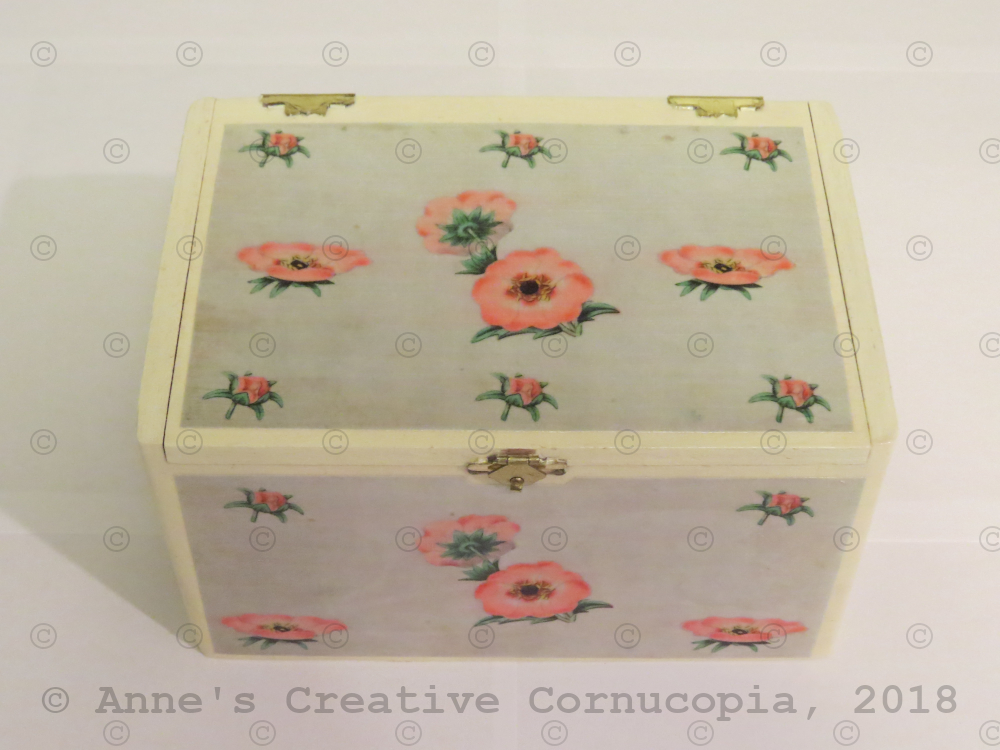
"Pink Flowers" - Wood Box

© All Rights Reserved
(Click on image to enlarge)

I made a pink flowers wood box for my sister, using a cigar box.

I created this using GIMP 2.10.4.

The vintage images are from an Internet search. (See the side of my blog for links.)

"Arcana Pentacle Raven" - Wood Box

© All Rights Reserved
(Click on image to enlarge)

I made another pentacle raven wood box, using a playing card box, similar to this design and this design.

I created this using GIMP 2.10.4.

The vintage images are from an Internet search. (See the side of my blog for links.)

Monday, July 16, 2018

"Arcana Pentacle Raven" - Wood Box

© All Rights Reserved
(Click on image to enlarge)

I made another gold Pentacle Raven wood box similar to this one, using a cigar box.

I created this using GIMP 2.10.4.

The vintage images are from an Internet search. (See the side of my blog for links.)

Because everything in my design is old, I am entering it in this week's Tuesday's Treasures.


Materials:

cigar box

Martha Stewart Vintage Gold Metallic Paint (346 433 / M18121)

Delta (Plaid) Ceramcoat Gloss Interior Varnish

Steps:

I used Goo Gone to remove the labels from the cigar box, but there was still some stickiness left. I sanded those spots with fine sandpaper.

I painted the outside of the box with one coat of Martha Stewart Vintage Gold Metallic Paint and let it dry. (Note: to save paint, I only painted the outer edges where I would be applying decoupage panels.) I left the inside of the box unpainted. (I had wax paper underneath the box while I worked on it.)

I printed my Pentacle Raven box decoupage panels on card stock, then cut them out. I placed them on the dry box, and made fine adjustment cuts to them so that they would fit on the the box. (Note: I only needed to cut the front panel where the box latch was. The other panels fit as is.)

This time I did not allow 24 hours for the inkjet ink to dry completely on the card stock paper, before proceeding to the decoupage steps. (Note: the ink might have run a little, but not enough to ruin the appearance of the design.)

I applied a thin layer of Delta (Plaid) Ceramcoat Gloss Interior Varnish to the top of the box. I carefully lined up and placed the top decoupage panel onto the box. (Note: there is a very short period of time to adjust the panel a little bit, if it is slightly crooked.) I pressed all over the panel with my fingers to adhere it to the gloss coat and remove any air bubbles. (Note: maybe using the decoupage brayer roller would have been better.)

I waited for the top to dry, before repeating the decoupage "glue" step for the left side, front, and right side of the box.

I placed the box back on the wax paper and allowed time for it to dry.

I applied a thin layer of Delta (Plaid) Ceramcoat Gloss Interior Varnish to the top only, to coat the decoupage panel. (Note: Either because of the humidity in the air or not waiting long enough for the "glue" coat to dry, the top panel bubbled during this step. I used plastic wrap over my hand to press down on the bubbled areas to try to flatten them. When the panel dried, it was flat.)

I waited for the top to dry, before repeating the decoupage "coating" step for the left side, front, and right side of the box, to coat the decoupage panels. (Note: this first "coating" step is when the inkjet ink ran a little, but not enough to ruin the appearance of the design.) I also applied it to the back of the box and the visible lid edges, then allowed time for the box to dry.

Note: The front panel bubbled just like the top panel had. So I again used plastic wrap over my hand to press down on the bubbled areas to try to flatten them. This time the bubbles did not flatten, so I let the box dry a little, then placed the box with the back down and the front up. I put the plastic wrap over the front, then put books on top of that, to flatten the panel.

I waited until the next day to apply a second coat of Delta (Plaid) Ceramcoat Gloss Interior Varnish to the top, left side, front, right side, back, and visible lid edges of the box. (I chose not to coat the bottom of the box, nor the inside.)

I decided two coats was enough, and the box was done! (Note: I forgot to adhere my date created card stock paper to the inside of the box, so I did that as a final step.)